The Body Can Remember a Future It Has Not Reached
Sixteen years after immature testicular tissue was frozen, it resumed development inside the adult body that had once produced it. The case connects biological continuity, childhood medical care, reproductive identity and our unusual capacity to invest in uncertain futures.
Childhood tissue preservation and future reproductive potential
Can frozen childhood tissue produce sperm years later?
Yes, in one reported human case. Researchers transplanted immature testicular tissue that had been cryopreserved for 16 years back into the adult patient from whom it was collected during childhood. Some intratesticular grafts revascularized and established spermatogenesis. The finding demonstrates biological feasibility, but it does not yet prove reliable fertility restoration, fertilization, pregnancy or live birth.
What happened?
In the first reported human case of its kind, immature testicular tissue preserved during childhood for 16 years was transplanted back into the adult patient. Some grafts placed inside the testis revascularized and established spermatogenesis. The findings came from one patient and were reported in a preprint that had not completed formal peer review at the time of publication.
Why is it scientifically important?
The case shows that immature human testicular tissue can survive long-term cryostorage and later respond to an adult reproductive environment. It establishes biological feasibility, although it does not yet demonstrate a dependable fertility treatment or a resulting live birth.
What is the evolutionary connection?
Humans have an unusually slow life-history strategy, marked by extended childhood, delayed reproduction and prolonged parental investment. Fertility preservation uses modern medicine to extend that pattern: adults invest resources during childhood to protect a reproductive option that may become valuable many years later.
What is the ethical issue?
A child cannot fully determine whether genetic parenthood will matter to his adult identity. Parents and physicians may preserve the option, but its later use should remain under the adult patient’s control. Ethical care therefore requires honest consent, long-term stewardship, disease-specific safety assessment and equitable access.
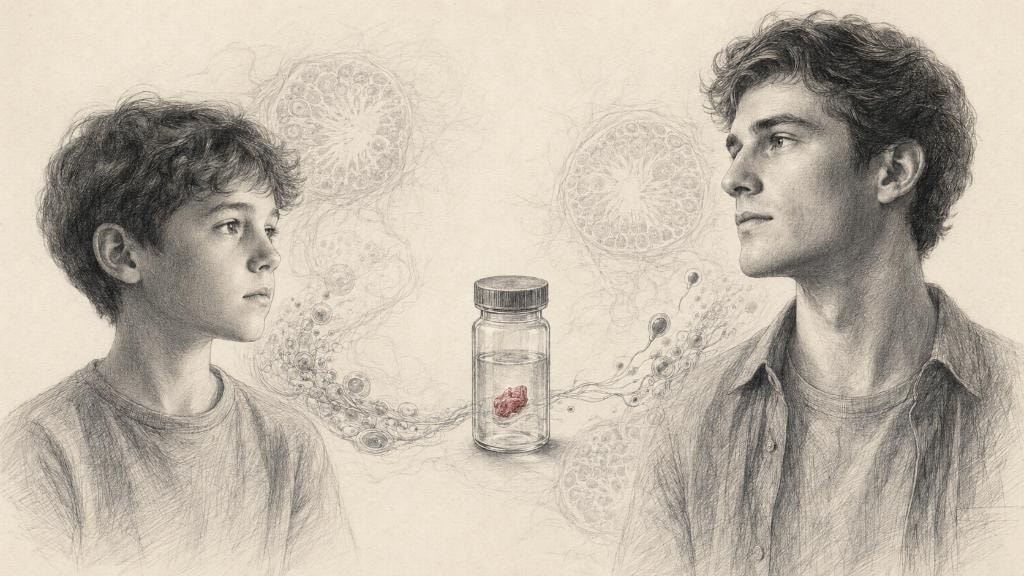
A ten-year-old boy facing intensive medical treatment could not yet produce sperm. He may not have known whether he would ever want children. His physicians could not promise that a technology capable of restoring his fertility would exist when he became an adult.
They preserved part of his immature testicular tissue anyway.
Sixteen years later, researchers thawed fragments of that tissue and returned them to his body. Some of the grafts revascularized, responded to the adult hormonal environment, and completed the cellular process required to produce sperm. Tissue removed from a child had retained a biological capacity that the child himself had never used.
The phrase “the body can remember” needs care. Cells do not imagine adulthood, parenthood, or a future child. The frozen tissue held living developmental potential: spermatogonial stem cells, supporting cells, tissue architecture, and molecular systems capable of responding when the right environment finally arrived.
The remarkable part lies in the relationship between biology and foresight. A child’s cells preserved one possible reproductive future. Adults, institutions, and medical technology kept that possibility alive until he was old enough to decide whether it belonged in his life.
Key terms
Spermatogonial stem cells: Cells in the testes that can renew themselves and eventually develop into sperm.
Spermatogenesis: The multistage process through which germ cells develop into mature sperm.
Cryopreservation: Storage of cells or tissue at extremely low temperatures to slow biological activity and prevent degradation.
Autologous transplantation: Returning a person’s own cells or tissue to that same person.
Gonadotoxic treatment: Chemotherapy, radiation, or another treatment capable of damaging reproductive cells and organs.
Azoospermia: The absence of sperm in ejaculated semen.
What the transplant actually demonstrated
The case was reported in a March 2026 preprint led by reproductive biologist Ellen Goossens and colleagues at Vrije Universiteit Brussel and associated clinical centers. Goossens and colleagues’ 2026 preprint had not completed formal peer review at the time of publication.
One factual correction is also important. Some public descriptions have framed the patient as a childhood cancer survivor. According to the research report, he received gonadotoxic treatment during childhood for sickle cell disease, including chemotherapy associated with hematopoietic stem-cell transplantation. The technique is highly relevant to childhood cancer care, but this particular patient was not treated for cancer.
Before treatment in 2008, when the patient was ten, clinicians removed and cryopreserved immature testicular tissue. Prepubertal boys generally cannot bank an ejaculated sperm sample because spermatogenesis has not begun. Their tissue can contain spermatogonial stem cells, but whether those cells can later produce clinically usable human sperm has remained an open question.
After the patient reached adulthood, testing showed persistent azoospermia. Sixteen years after the tissue had been frozen, the researchers thawed eleven fragments and placed them at intratesticular and subcutaneous scrotal sites. Roughly one year later, the grafts were retrieved and examined.
The results depended strongly on location. Two of the four grafts placed inside the remaining testis contained spermatogonial stem cells and evidence of active spermatogenesis. The researchers reported complete spermatogenesis in the intratesticular tissue. The grafts placed beneath the scrotal skin developed supporting tissue but contained no detectable germ cells (Goossens et al., 2026). Sperm production, fertilization, pregnancy and live birth are different evidentiary milestones; this case established the first, not the others.
That difference is biologically informative. Preserved potential was insufficient by itself. The tissue needed an appropriate ecological setting inside the body: blood supply, temperature, hormonal signals, neighboring cells, and local molecular conditions.
A seed may remain viable for years, but viability does not erase the need for soil.
Biological continuity without conscious memory
What, precisely, persisted during those sixteen years?
The simplest hypothesis is cellular preservation. Cryopreservation reduced metabolic activity enough to preserve viable stem cells and elements of the tissue environment. When the tissue returned to a living body, some of its developmental processes resumed.
This hypothesis predicts that success will depend on measurable biological features: the number and condition of spermatogonial stem cells, the preservation method, duration of storage, tissue architecture, quality of revascularization, graft location, and the adult hormonal environment.
A second hypothesis concerns the preservation of a developmental system, rather than isolated cells alone. Spermatogenesis requires communication among germ cells, Sertoli cells, Leydig cells, blood vessels, hormones, and the structures of the seminiferous tubules. The success of intratesticular grafts, together with the failure to detect germ cells in the subcutaneous grafts, suggests that the surrounding environment helped determine which biological possibilities could be expressed.
This hypothesis predicts that intact tissue fragments may sometimes perform differently from isolated stem cells, and that transplantation sites reproducing the normal testicular environment will have better outcomes.
Neither account requires the tissue to “know” its future. The continuity resides in biological organization. The cells retained the capacity to interpret later signals.
This is a central principle of developmental biology: genes carry information, but development emerges from genes working inside cells, cells working inside tissues, and tissues responding to environments. Biology stores possibilities more often than fixed destinies.
An evolutionary view: reproduction is delayed, distributed and social
Natural selection ultimately depends on differential reproduction. Yet humans evolved a life history in which reproduction comes late and depends heavily on investment accumulated over many years. This distinction follows a basic principle of natural selection: evolutionary explanations concern fitness consequences, not moral instructions.
Human children grow slowly. They require prolonged feeding, protection, learning, and social support. John Bock’s work on embodied capital helps explain this pattern. Embodied capital refers to the skills, knowledge, physical development, health, and social competence accumulated across a lifetime. Human beings spend an unusually long childhood building capacities that may yield benefits much later (Bock & Johnson, 2004).
Fertility preservation extends this delayed-investment system into medicine. Resources are spent during childhood to retain an option that may become valuable only in adulthood. The immediate payoff is zero. The possible return lies decades ahead and depends on survival, recovery, personal preference, reproductive opportunity, and future medical capability.
Kristen Hawkes’s research on human life history and Sarah Blaffer Hrdy’s work on cooperative breeding point toward another relevant feature: human reproduction has rarely been an isolated act performed by two self-sufficient individuals. Human offspring have often depended on parents, grandparents, siblings, other relatives, and wider cooperative networks. The medical system involved in this case extends older patterns of human cooperation and parental investment.
This transplant follows the same broad social pattern in a technologically new form. The child supplied the tissue. Parents or guardians likely participated in consent. Clinicians collected it. Laboratories maintained it. Institutions preserved records and custody. Researchers developed the transplantation method. The adult patient ultimately decided whether to use it.
Biological continuity was carried by tissue. Reproductive possibility was carried by a cooperative system.
This does not mean cryopreservation evolved as an adaptation. It plainly did not. The technology is culturally recent. It recruits older human capacities: long-term parental investment, planning under uncertainty, cooperation among non-kin specialists, and concern for descendants who do not yet exist.
Robert T. Boyd, Peter J. Richerson, and Joseph Henrich have shown how cumulative culture allows human groups to preserve and improve knowledge beyond the competence or lifespan of any one individual. No single participant in this case had to invent cryobiology, stem-cell science, microsurgery, reproductive endocrinology, and clinical governance. Each inherited part of a cultural system and added a small contribution.
The preserved tissue waited sixteen years. The knowledge required to use it had been accumulating much longer.
Two meanings of reproductive identity
The case also raises a question that biology alone cannot settle: what does it mean to preserve someone’s reproductive identity?
One interpretation is genetic continuity. The tissue may allow the patient to produce gametes carrying his genome and, with a reproductive partner or donor, to conceive a genetically related child. From an evolutionary perspective, this is the most direct connection to reproduction.
A second interpretation is biographical continuity. The adult may experience the preserved tissue as a physical connection between his life before treatment and his life after survival. The tissue came from his childhood body, yet its use depends on the preferences of the adult he became.
These meanings can overlap, but they should not be treated as universal. Some survivors place great importance on genetic parenthood. Others prefer adoption, donor gametes, remaining without children, or building family through different relationships. Infertility can affect identity and well-being, but genetic reproduction does not define a complete human life.
Evolutionary explanations describe why reproductive possibilities can become emotionally and socially important. They do not determine what any person ought to value.
This distinction protects both scientific accuracy and patient autonomy. A reproductive option is valuable partly because the individual retains the authority to refuse it.
Evidence, interpretation and speculation
Evidence
The 2026 report documents one human case in which immature testicular tissue survived sixteen years of cryostorage, revascularized following autologous transplantation, and established spermatogenesis in intratesticular grafts. The findings support the biological feasibility of the procedure (Goossens et al., 2026).
Worldwide, tissue-banking programs have cryopreserved testicular tissue from more than 3,000 boys, although clinical use remains limited and experimental, according to a 20-year overview of fertility preservation in boys (Duffin et al., 2024). Animal research, including work in nonhuman primates, provided important proof of concept before the first reported human result. An expert review of immature testicular tissue transplantation published in 2025 outlines the clinical-implementation questions that remain open (Safrai et al., 2025).
Interpretation
The case suggests that long-term cryopreservation can maintain more than cellular survival. Under appropriate conditions, preserved immature tissue may resume a developmental process interrupted before puberty.
It also demonstrates that medical care can reach forward across different stages of one person’s life. A decision made during childhood can preserve an option for an adult whose preferences were unknowable at the time.
Speculation
It is too early to conclude that this approach reliably restores fertility. Evidence of spermatogenesis does not establish that the resulting sperm can consistently fertilize an egg, produce a healthy embryo, or lead to a live birth.
The report involves one patient. We do not yet know the success rate across diagnoses, treatment exposures, ages at collection, freezing protocols, storage durations, tissue conditions, or transplantation techniques. We also do not know whether autotransplantation is safe for every group of survivors.
In patients whose original disease involved malignant cells, reintroducing tissue may create a risk of returning contaminated cells to the body. That risk will differ by disease and must be evaluated before transplantation. In vitro maturation or purified-cell approaches may eventually offer alternatives for some patients, but those methods also remain under development.
The ethics begin before the tissue is frozen
Current guidance from the 2025 American Society of Clinical Oncology fertility-preservation guideline states that testicular tissue cryopreservation in prepubertal boys remains experimental and should be offered through a clinical trial. Established fertility-preservation methods should be discussed before cancer-directed treatment when possible, with appropriate specialist referral (Su et al., 2025).
That classification should not be quietly weakened because one case succeeded. A proof of biological possibility is a major scientific step. It is not a mature clinical guarantee.
Families therefore need clear consent processes. They should understand:
- The procedure may never produce clinically usable sperm.
- Storage may continue for many years and create financial or administrative burdens.
- Future use should require the adult patient’s consent.
- Tissue ownership and disposition must be addressed if the patient dies, cannot be contacted, or no longer wants storage.
- Disease-specific safety may rule out direct transplantation.
- Access may depend on geography, insurance coverage, research eligibility, and the ability to pay.
The access problem is especially difficult. A technology that preserves future reproductive choice only for families who can reach specialized centers and sustain long-term storage may widen existing inequalities. Medical progress should therefore be measured through safety and efficacy, along with who receives counseling, who is offered preservation, who pays for storage, and who can eventually use the tissue.
What would change my mind?
I would become more confident that this is a clinically reliable fertility-restoration method if:
- Peer-reviewed studies reproduce the result in multiple patients and treatment groups.
- Researchers report healthy fertilization, embryo development, pregnancy, and live-birth outcomes.
- Long-term follow-up finds no unexpected genetic, developmental, endocrine, or cancer-related harms.
- Standardized protocols identify which patients, tissues, preservation methods, and graft sites have acceptable success rates.
- Access studies show that counseling and treatment are reaching patients across income, racial, geographic, and insurance groups.
I would become more cautious if later research finds that mature sperm production is rare, grafts lose germ cells unpredictably, the genetic integrity of resulting sperm is compromised, or disease-contamination risks cannot be controlled.
A future held open
This case does not show that the body literally remembers an imagined future. It shows something more defensible and, in its own way, more remarkable.
Living tissue taken before puberty can retain a developmental capacity for sixteen years. An adult body can receive that tissue and provide conditions in which part of its interrupted biology resumes. Medicine can preserve a possibility before the patient is old enough to understand why he might value it.
Evolution produced organisms capable of reproduction. Human life history made reproduction unusually delayed and dependent on long investment. Culture added tissue banks, clinical ethics, microsurgery, and scientific institutions able to maintain a biological option across decades.
The cells carried continuity. Other people carried responsibility.
Whether the patient eventually uses the resulting sperm remains his decision. That is the ethical center of the achievement. Medicine did not choose his future. It kept one future from disappearing before he was able to choose for himself.
Key takeaways
- The first reported human case demonstrated spermatogenesis after autologous transplantation of immature testicular tissue stored for sixteen years.
- The patient received gonadotoxic childhood treatment for sickle cell disease, although the method also has major implications for childhood cancer survivors.
- The finding demonstrates biological feasibility, but it does not yet establish reliable fertility restoration or a live-birth outcome.
- The success of intratesticular grafts shows that preserved cells still depend on an appropriate tissue environment.
- From an evolutionary perspective, fertility preservation extends the human pattern of delayed development, parental investment, cooperation, and planning under uncertainty.
- Ethical implementation requires patient autonomy, honest consent, disease-specific safety controls, long-term stewardship, and equitable access.
References and further reading
Bock, J., & Johnson, S. E. (2004). Male migration, remittances, and child outcome among the Okavango Delta peoples of Botswana. In C. S. Tamis-LeMonda & N. Cabrera (Eds.), Handbook of father involvement: Multidisciplinary perspectives (pp. 308–335). Lawrence Erlbaum Associates.
Boyd, R., & Richerson, P. J. (1985). Culture and the evolutionary process. University of Chicago Press.
Duffin, K., et al. (2024). A 20-year overview of fertility preservation in boys. Frontiers in Endocrinology, 15. PubMed Central
Goossens, E., Vloeberghs, V., De Beer, E., Delgouffe, E., Mateizel, I., Ernst, C., Waelput, W., Gies, I., & Tournaye, H. (2026). First successful transplant of human immature testicular tissue after gonadotoxic therapy during childhood: Complete spermatogenesis in intra-testicular grafts. medRxiv. Advance preprint. https://doi.org/10.64898/2026.03.04.26347483
Hawkes, K., O’Connell, J. F., Blurton Jones, N. G., Alvarez, H., & Charnov, E. L. (1998). Grandmothering, menopause, and the evolution of human life histories. Proceedings of the National Academy of Sciences, 95(3), 1336–1339.
Henrich, J. (2016). The secret of our success: How culture is driving human evolution, domesticating our species, and making us smarter. Princeton University Press.
Hrdy, S. B. (2009). Mothers and others: The evolutionary origins of mutual understanding. Harvard University Press.
Picton, H. M., et al. (2015). A European perspective on testicular tissue cryopreservation for fertility preservation in prepubertal and adolescent boys. Human Reproduction, 30(11), 2463–2475. Oxford Academic
Safrai, M., Goossens, E., Mitchell, R. T., Orwig, K. E., Mulder, C. L., van Pelt, A. M. M., Gook, D. A., Feraille, A., Delgouffe, E., Ginsberg, J. P., Stukenborg, J.-B., & Duffin, K. (2025). Is the time right for transplanting immature testicular tissue or cells to restore male fertility? Expert perspectives on clinical implementation. Human Reproduction Update. PubMed
Su, H. I., et al. (2025). Fertility preservation in people with cancer: American Society of Clinical Oncology guideline update. Journal of Clinical Oncology. https://doi.org/10.1200/JCO-24-02782
Written by Farzin Espahani
Editor in Chief, The Hominid Post
Farzin Espahani writes about human behavioral ecology, evolutionary anthropology, cooperation and the institutions humans build around biological and social risk.