Did Humans Evolve to Spend All Day With One Partner?
Long-term pair bonds are ancient. Spending most of the day alone with the same person for decades may be a very different social arrangement.
Did Humans Evolve to Spend All Day With One Partner?
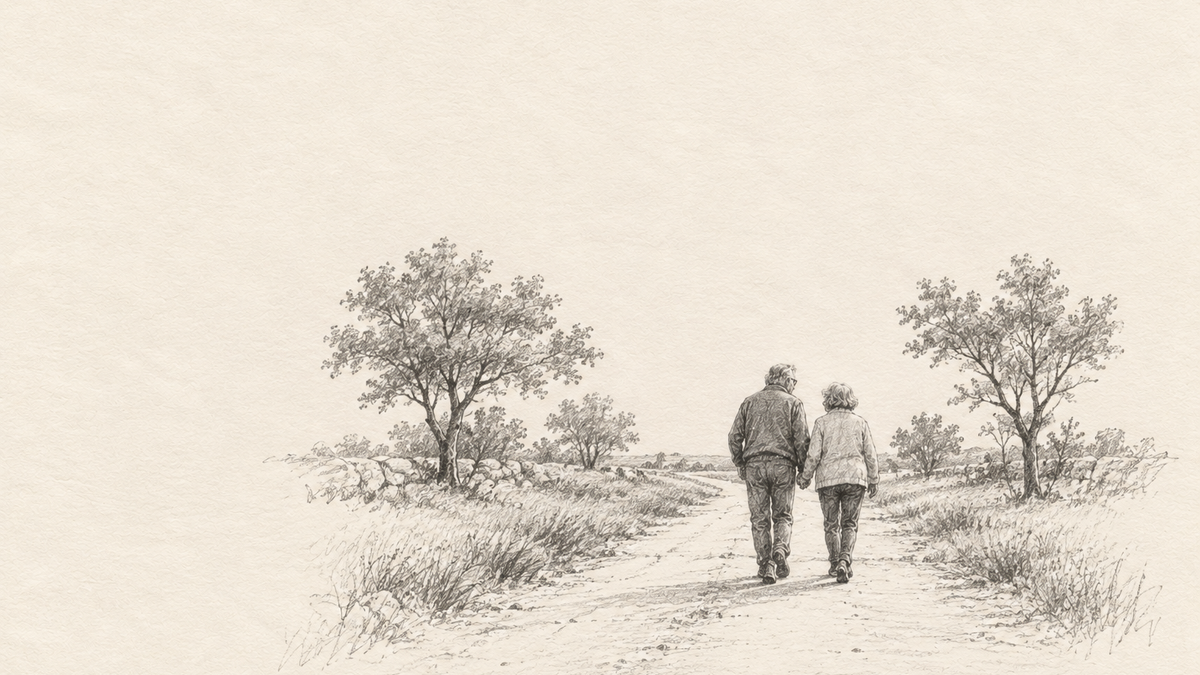
Imagine a husband and wife who have been married for more than 50 years. Their children have left home. Both are retired. They wake together, eat together, run errands together, watch television together, travel together, and sleep in the same house. On an ordinary day they may spend 12 to 15 waking hours in one another's presence, with only brief interactions with anyone else.
There is nothing inherently unhealthy about this arrangement. Many couples enjoy it.
But from an evolutionary perspective, it raises an interesting question.
Humans clearly evolved the capacity to form strong and sometimes remarkably durable pair bonds. Did those bonds evolve in a social environment where two adults were expected to become almost the entirety of one another's daily social world?
The evidence points toward a distinction. Pair bonding has deep evolutionary roots. Human social life also has deep roots in kin groups, friendships, alliances, food-sharing relationships, cooperative parenting and wider networks of people who repeatedly move in and out of daily life.
A marriage can therefore be ancient in its basic form while the modern socially isolated couple represents a relatively unusual ecological arrangement.
The Pair Bond Is Old
Any evolutionary argument about marriage has to begin by resisting an easy mistake: humans are highly social animals, but that does not mean pair bonds are merely recent cultural inventions.
Comparative work on hunter-gatherer marriage suggests a long evolutionary history of socially recognized pair bonds. Walker, Hill, Flinn and Ellsworth found that marriage is widespread across human societies and argued that institutionalized pair bonding probably reaches back at least to early modern humans. Their reconstruction also suggests relatively low levels of polygyny in ancestral hunter-gatherer societies and substantial involvement of families in marriage and resource exchange (Walker et al., 2011).
The important part is that marriage historically linked more than two individuals. A marriage could connect families, kin groups and coalitions. Walker and colleagues describe mate and resource exchange as contributing to alliances spanning multiple residential communities.
The neurobiology of attachment points in the same general direction regarding the importance of the pair bond itself. Helen Fisher, Arthur Aron and Lucy Brown proposed three partly distinct but interacting systems involved in human reproduction: sexual desire, attraction toward a particular mate and longer-term attachment. Attachment, in their formulation, helps maintain proximity between partners long enough to accomplish species-specific parenting duties (Fisher et al., 2006).
Long-term attachment therefore requires no special modern explanation. Humans appear well equipped to become deeply attached to particular people.
The more interesting question concerns the social ecology surrounding that attachment.
A Pair Was Usually Part of Something Larger
Hunter-gatherer societies differ enormously. There was no single ancestral village, marriage system or daily schedule that can stand in for several hundred thousand years of human evolution.
Robert Foley warned specifically against treating hunter-gatherers as one uniform social type. Group size, mobility, subsistence, residence and social organization vary considerably across environments and populations.
That caution matters. We cannot say that an ancestral husband left camp for exactly eight hours while his wife gathered with a fixed group of relatives. Human behavioral ecology predicts variation because different environments create different costs and benefits.
A broader pattern, however, appears repeatedly: human pair bonds existed inside larger social systems.
Hill and colleagues examined co-residence patterns across 32 foraging societies involving 5,067 adults. The average experienced band contained about 28 adults. They found that either sex might remain with or leave the natal group, adult brothers and sisters often lived together, and most adults within residential groups were genetically unrelated. Human camps therefore brought together spouses, relatives and unrelated cooperators rather than functioning simply as collections of isolated nuclear families (Hill et al., 2011).
Foley describes a similarly nested structure at a broader evolutionary scale: smaller family-like units situated within larger communities and day-to-day social groupings.
This changes how we should picture ancestral marriage.
A wife could be the most important adult in her husband's life without being his only important adult. A husband could be a major provider and attachment figure without being expected to satisfy every conversational, emotional, recreational, productive and social need his wife had.
Pair bonding and group living operated together.
Work Also Separated People
Subsistence created another important difference between many small-scale societies and the contemporary retired household.
People had things to do, and those activities often placed spouses in different social combinations.
Among the Conambo population studied by John Q. Patton, men commonly hunted alone, in pairs or in small groups, while women were primarily responsible for gardening. Hunting, food processing, visiting and meat distribution created repeated interactions beyond the marital pair.
Food itself moved across household boundaries.
Patton found that meat sharing in Conambo reflected several overlapping relationships, including kinship, reciprocity and political alliance. Men transferred more meat to households whose male heads were likely to support them during conflicts.
That matters for marriage because economic life and social life were intertwined. Getting food, raising children, maintaining alliances, learning skills and managing risk repeatedly brought other people into the household's survival strategy.
The spouse remained important, but the household was connected to a web of reciprocal obligations.
Modern affluence can remove much of this dependency.
A retired couple in a suburban home can obtain food, electricity, transportation, entertainment, banking, medical appointments and household goods while barely interacting with relatives or neighbors. Many services that once required human cooperation have been transferred to markets, institutions and technology.
Material independence from other people can quietly become social dependence on one person.
Children Were Rarely a Two-Person Project
Human childhood makes the comparison even stronger.
Human children are expensive. They mature slowly, require long periods of provisioning and acquire large amounts of learned knowledge before reaching adult competence.
One proposed response to this unusually demanding life history is cooperative childrearing.
Research among South American hunter-gatherers found that parents were supported by provisioning from people outside the reproductive pair. Fathers were important, but help could also come from grandparents and other adults. The broader ethnographic literature includes childcare, food provisioning, carrying children, obtaining water and firewood, constructing shelters, caring for injured individuals and sharing ecological knowledge among the forms of assistance exchanged in foraging societies.
This fits Sarah Blaffer Hrdy's broader argument that humans show important features of cooperative breeding: mothers historically depended on assistance from other people to raise unusually costly offspring. Reviews of hunter-gatherer research likewise emphasize the importance of allomothering — care and provisioning by individuals other than the mother — as a distinctive feature of human social organization.
John Bock's work adds another layer. His embodied-capital framework treats parenting as investment not only in calories and physical growth but also in knowledge, skill and competence. Different people can contribute different forms of investment depending on ecology and economic organization.
Again, the pattern is broader than marriage.
The human reproductive system contains a pair bond, but it has repeatedly operated through networks of additional contributors.
Fifty Years Together Is Not the Strange Part
There is a tempting argument here that should be avoided.
One might assume humans simply did not live long enough for 40- or 50-year relationships to matter evolutionarily.
That would be too simple.
Mortality was much higher in small-scale societies, especially during infancy and childhood, but substantial adult longevity predates modern medicine. Gurven and Kaplan's cross-cultural analysis of hunter-gatherer and small-scale populations concluded that post-reproductive longevity is an old human feature rather than a recent product of hospitals, antibiotics and sanitation. They estimated an evolved adult lifespan broadly compatible with survival into the seventh decade for individuals who survived earlier mortality hazards (Gurven & Kaplan, 2007).
Long relationships were therefore biologically possible.
Modern societies have still changed the probability distribution dramatically. More people survive childhood, more couples reach old age together, fertility is lower, children leave home, retirement can last decades, and paid employment eventually disappears.
The evolutionary novelty may therefore be less about loving one person for 50 years and more about two people surviving long enough, healthy enough and economically independent enough to spend the final 20 or 30 years primarily in each other's company.
That is a different proposition.
The Social Load Placed on a Modern Spouse
Consider what one spouse may be expected to provide in a socially narrow household.
The same person can become the primary confidant, recreational partner, travel companion, dinner companion, emotional support, household collaborator, caregiver, source of physical affection, television companion, political sounding board, medical advocate and audience for everyday stories.
That is an enormous number of social functions concentrated in one relationship.
If a couple literally spent 15 waking hours together every day for 50 years, the arithmetic would approach 274,000 hours of shared exposure.
Humans can clearly tolerate extraordinary familiarity. Long marriages demonstrate that.
The evolutionary question is whether our psychology performs best when one relationship carries so many functions simultaneously.
There is already some evidence from aging research that broader relationships remain relevant even within good marriages. In a population-based study of 953 older heterosexual couples, greater closeness to confidants was associated with higher marital quality for both husbands and wives. The authors concluded that high-quality relationships with family and friends can matter for the marital relationship itself (Zhaoyang & Martire, 2018).
Research involving married adults in their eighties also found that more daily time spent with other people was associated with greater happiness. Time with a spouse depended more strongly on the quality of the marriage: when marital satisfaction was high, spousal time was associated with different emotional outcomes than when marital satisfaction was poor (Waldinger & Schulz, 2010).
These findings do not prove an evolutionary mismatch. They do show that a spouse does not make the rest of the social world psychologically irrelevant.
Competing Hypotheses
Pair-bond sufficiency hypothesis: Humans possess attachment mechanisms capable of making a partner the dominant social companion for very long periods. If the relationship remains cooperative and affectionate, extensive time together should be psychologically sustainable.
Social-network hypothesis: Human pair bonds evolved within larger networks of kin, friends, allies and cooperators. A spouse can be central without carrying nearly the entire social load. Chronic narrowing of the network may therefore place demands on the pair bond that were less common in many ancestral environments.
Cultural adaptation hypothesis: Humans are behaviorally flexible enough that modern couples can develop norms, hobbies, technologies and institutions that compensate for changing social ecology. There need not be a simple evolutionary mismatch at all.
These hypotheses can coexist to some degree. Humans can possess strong pair-bonding adaptations while also benefiting from broader networks.
The disagreement concerns how much social concentration the pair bond can absorb before costs begin to appear.
What Each Hypothesis Predicts
If pair-bond sufficiency is the main explanation, couples who voluntarily spend very large portions of their days together should generally do well when marital quality is high. Independent friendships and activities may be enjoyable but should contribute relatively little once relationship quality, health and socioeconomic conditions are accounted for.
The social-network hypothesis predicts something different. Among otherwise comparable couples, marital quality should be more resilient when each spouse maintains meaningful relationships outside the marriage. Some overlap would be expected, but complete network overlap should offer fewer opportunities for independent affiliation, information, status and identity.
It also predicts that major transitions that suddenly compress social networks — retirement, relocation, disability, loss of friends or children moving away — could affect the marriage even when neither partner has fundamentally changed.
That prediction is testable.
Retirement provides a particularly useful natural experiment because employment simultaneously structures time, identity and social contact. Contemporary research shows that retirement can alter network size, overlap and patterns of interaction, although those effects vary by sex and population.
The cultural-adaptation hypothesis predicts substantial variation. Couples embedded in strong neighborhoods, religious communities, clubs, extended families or online networks may experience retirement differently from couples with very small networks even when their hours at home are similar.
Evidence, Interpretation and Speculation
Evidence: Humans form long-term pair bonds. Marriage has a deep history. Human residential groups have also historically included mixtures of kin and nonkin, and cooperation regularly extends beyond the reproductive pair. Childrearing, food acquisition, learning and risk management have frequently involved multiple people. Hunter-gatherer societies are highly variable, so no single group should be treated as a fossilized model of the human past.
Interpretation: A modern household containing two retired spouses can concentrate social interaction more heavily within the pair than was typical in many small-scale social environments. That interpretation follows from the contrast between networked subsistence societies and households whose material needs are increasingly supplied through markets and institutions. It does not establish that constant marital proximity is harmful.
Speculation: Some forms of late-life marital friction may result partly from asking one relationship to perform too many social functions. This remains a hypothesis. I am not aware of evidence demonstrating a specific evolutionary threshold — eight hours together is healthy, twelve is dangerous, fifteen is excessive. Such numbers would be invented. The useful claim is narrower: social network structure deserves consideration when studying long-term marriage.
A Different Way to Think About a Successful Marriage
Evolutionary reasoning does not imply that spouses should spend less time together.
It suggests that a strong marriage and a strong social network may complement one another.
For most of human history, attachment did not require social exclusivity. People could maintain deep pair bonds while remaining sons, daughters, siblings, grandparents, hunting partners, gathering partners, friends, storytellers, teachers, allies and members of wider communities.
Modern couples sometimes preserve all of those roles.
Others gradually lose them.
Work ends. Parents die. Children establish separate households. Friends move away. Mobility declines. Community organizations weaken. One by one, relationships that once absorbed attention, conversation, identity and responsibility disappear.
The marriage remains.
It may then be asked to carry social weight it was never previously carrying.
There is something remarkable about two people remaining attached for half a century. Evolutionary anthropology gives us no reason to dismiss that achievement as unnatural.
It gives us reason to examine the environment around it.
The question may therefore be less whether humans evolved for lifelong love.
We have considerable evidence that humans evolved unusually powerful capacities for attachment, cooperation and long-term relationships.
The unresolved question is how those capacities function when the social world surrounding the pair becomes very small.
What Would Change My Mind
- Evidence showing that socially isolated couples consistently have equal or better long-term marital and psychological outcomes than equally satisfied couples embedded in wider networks.
- Time-allocation studies from multiple small-scale societies showing that spouses commonly spend nearly all waking hours primarily with one another.
- Longitudinal retirement research demonstrating that loss of independent social networks has little effect on relationship quality after controlling for health, income and prior marital satisfaction.
- Cross-cultural evidence showing that humans readily substitute one highly intensive pair relationship for broader social networks without measurable costs.
References & Further Reading
Fisher, H. E., Aron, A., & Brown, L. L. (2006). Romantic love: A mammalian brain system for mate choice. Philosophical Transactions of the Royal Society B: Biological Sciences, 361(1476), 2173–2186.
Foley, R. (1996). The adaptive legacy of human evolution: A search for the environment of evolutionary adaptedness. Evolutionary Anthropology, 4, 194–203.
Gurven, M., & Kaplan, H. (2007). Longevity among hunter-gatherers: A cross-cultural examination. Population and Development Review, 33(2), 321–365.
Hill, K. R., Walker, R. S., Božičević, M., Eder, J., Headland, T., Hewlett, B., Hurtado, A. M., Marlowe, F., Wiessner, P., & Wood, B. (2011). Co-residence patterns in hunter-gatherer societies show unique human social structure. Science, 331(6022), 1286–1289.
Hill, K., & Hurtado, A. M. (2009). Cooperative breeding in South American hunter-gatherers. Proceedings of the Royal Society B: Biological Sciences.
Patton, J. Q. (2005). Meat sharing for coalitional support. Evolution and Human Behavior, 26(2), 137–157.
Walker, R. S., Hill, K. R., Flinn, M. V., & Ellsworth, R. M. (2011). Evolutionary history of hunter-gatherer marriage practices. PLOS ONE, 6(4), e19066.
Waldinger, R. J., & Schulz, M. S. (2010). What's love got to do with it? Social functioning, perceived health, and daily happiness in married octogenarians. Psychology and Aging, 25(2), 422–431.
Zhaoyang, R., & Martire, L. M. (2018). Spouses' social network characteristics and marital quality among older couples. Innovation in Aging, 2(Suppl. 1), 471.
Written by Farzin Espahani
Editor in Chief, The Hominid Post
Farzin Espahani writes about human behavioral ecology, evolutionary anthropology, cooperation and the institutions humans build around biological and social risk.