The Human Brain May Have Evolved by Slowing Down
Human cognitive flexibility may depend partly on keeping neurons—and the immune cells that shape their connections—immature for longer.
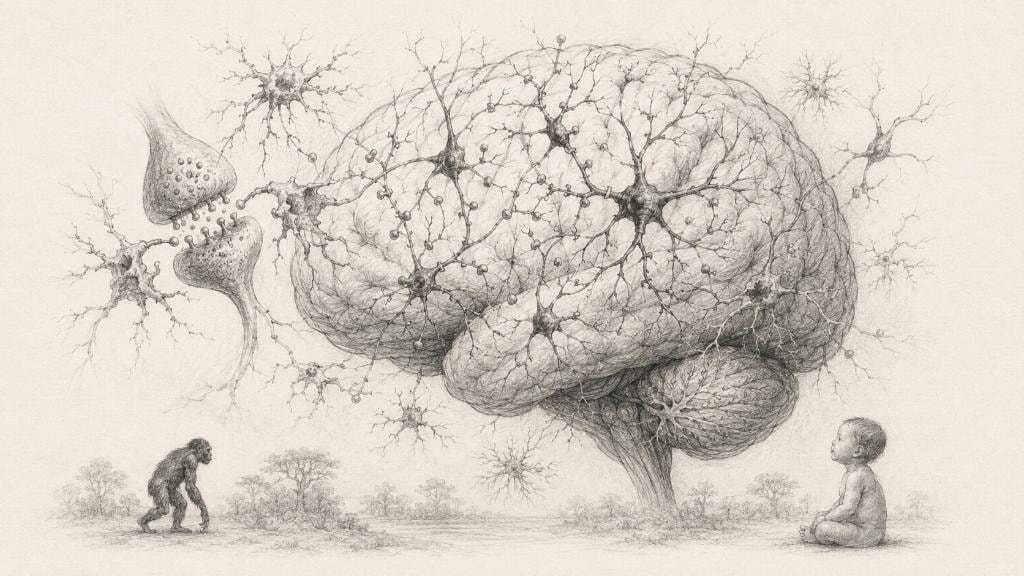
A mouse’s brain develops quickly. Human brain development continues through childhood and adolescence, requiring years of care, learning and social support before an individual can function independently.
This delay appears costly. Evolution, however, rewards outcomes under specific conditions rather than speed by itself. When survival depends on mastering difficult skills, navigating social relationships and learning knowledge that changes across environments, a longer developmental period can become valuable.
Scientists have long known that human neurons mature unusually slowly. New research published in Neuron adds another cell type to the story: microglia, the brain’s resident immune cells. Human-specific copies of a gene called SRGAP2 appear to slow the maturation of microglia as well as neurons, keeping both systems on a coordinated developmental timetable (Diaz-Salazar et al., 2026).
The study reveals a credible cellular mechanism through which human brain development became prolonged. It does not establish that delayed microglial maturation directly created language, creativity or general intelligence.
Short answer
Possibly. Human-specific copies of the SRGAP2 gene slow developmental features in neurons and microglia, the immune cells that help shape neural connections. This coordinated delay may extend the period during which experience can modify the developing brain. The research establishes a cellular mechanism, while its contribution to human intelligence remains an evolutionary hypothesis.
Why does the human brain develop so slowly?
Human development is unusually prolonged compared with that of most mammals. The brain continues reorganizing long after birth. Synapses form, strengthen, weaken and disappear across childhood as experience progressively shapes circuits involved in movement, perception, language and social behavior.
Evolutionary biologists use the term heterochrony for evolutionary changes in developmental timing. One form of heterochrony is neoteny, in which juvenile characteristics persist longer because development proceeds more slowly.
Comparative research has identified delayed human brain development at several levels. Gene-expression changes in the human prefrontal cortex occur later than comparable changes in chimpanzees and macaques (Somel et al., 2009). Human cortical neurons transplanted into mouse brains preserve a characteristically slow developmental schedule despite developing among faster-maturing mouse cells (Linaro et al., 2019). Cerebral organoids derived from human, chimpanzee and macaque cells also show species-specific differences in developmental tempo and gene regulation (Kanton et al., 2019).
Cellular metabolism appears to contribute to these differences. Experimental work suggests that mitochondrial metabolism helps set the pace at which neurons mature across species (Iwata et al., 2023). Brain development therefore has no single clock. Its timing emerges from several interacting molecular and cellular systems.
The delay is also part of a broader primate pattern. Chimpanzees experience extended juvenile synaptic development compared with monkeys, although the human timetable is longer in several important respects (Bianchi et al., 2013). Human development appears to extend and modify a tendency already present among great apes.
The new SRGAP2 research matters because it moves attention beyond neurons. The brain develops as a cellular ecosystem. Neurons, microglia, astrocytes and other cells must coordinate their activity across time.
Key terms
Microglia: Brain-resident immune cells that remove debris, respond to injury and help regulate developing neural circuits.
Synapse: A junction through which a neuron communicates with another cell.
Neoteny: The prolonged retention of juvenile characteristics because development proceeds more slowly.
Paralog: A gene copy produced by duplication within a genome. The copy may retain, divide or modify the ancestral gene’s functions.
Cell-autonomous effect: A change produced within the affected cell.
Non-cell-autonomous effect: A change in one cell that alters the development or behavior of neighboring cells.
What role do microglia play in brain development?
Microglia were once described mainly as the brain’s defensive and cleanup cells. They detect infection, engulf damaged material and help coordinate responses to injury.
That description captures only part of their function. During development, microglia interact with neurons and synapses. They influence which connections persist, which are removed and how responsive developing circuits become. Their role resembles continuous monitoring and calibration across a changing neural network.
This creates a developmental timing problem.
Human neurons remain plastic for years. A much faster microglial timetable could leave the two systems poorly coordinated. The cells helping shape the network would complete important stages of maturation while the network itself remained under construction.
Carlos Diaz-Salazar, Franck Polleux and their colleagues tested whether human microglia had also evolved a delayed schedule. Their research combined developmental transcriptomic data, human induced pluripotent stem cell-derived microglia, transplantation into mouse brains and genetically modified mouse models.
Human and mouse microglia followed broadly comparable developmental trajectories at sharply different speeds. Mouse microglia reached mature states in approximately three weeks. The developmental comparisons placed human microglial maturation across roughly four to eight years, according to the researchers’ analysis and Columbia University’s summary of the findings.
The next question concerned the mechanism controlling that delay.
How do human-specific SRGAP2 copies slow brain development?
Most mammals possess the ancestral gene SRGAP2A, which participates in cellular structure, neuronal migration and synaptic maturation.
In the lineage leading to humans, portions of this gene were duplicated several times. Genomic reconstruction places the origin of SRGAP2B at approximately 3.4 million years ago and SRGAP2C at roughly 2.4 million years ago (Dennis et al., 2012).
These dates overlap broadly with important changes in hominin evolution, including the early history of the genus Homo. Temporal overlap cannot tell us whether the duplications caused larger brains, toolmaking, language or any particular behavior. Fossils preserve anatomy and artifacts; they do not preserve the developmental activity of individual genes.
The copied genes are incomplete versions of the ancestral gene. That incompleteness created a new effect. The protein produced by SRGAP2C can bind to the ancestral SRGAP2A protein and reduce its activity. In neurons, this interference delays the maturation of dendritic spines—the small structures that commonly receive synaptic inputs—and increases spine density (Charrier et al., 2012).
Later research found that the human-specific SRGAP2 copies help maintain the slow maturation of human cortical synapses. When researchers reduced the activity of these copies in human neurons, synaptic development accelerated (Libé-Philippot et al., 2024).
The 2026 Neuron study extends the mechanism to microglia. Diaz-Salazar and colleagues found that the human-specific SRGAP2 paralogs were expressed at substantially higher levels in microglia than in neurons. Their experiments indicated that SRGAP2B and SRGAP2C were necessary and sufficient for several delayed features of human microglial maturation.
The effect also extended beyond the immune cells. Manipulating SRGAP2 activity specifically in microglia changed the timing of synaptic development in nearby cortical pyramidal neurons. A genetic change operating within one cell population therefore influenced the development of another.
A deep-time developmental timeline
| Approximate time | Development | What the evidence supports |
|---|---|---|
| Before the human lineage diverged | Ancestral SRGAP2A | A conserved gene involved in cellular and neuronal development |
| About 3.4 million years ago | SRGAP2B duplication | A partial human-lineage copy of the ancestral gene appears |
| About 2.4 million years ago | SRGAP2C duplication | A stable copy capable of inhibiting ancestral SRGAP2A activity emerges |
| Later hominin evolution | Prolonged brain development | Archaeology and fossils cannot isolate the cognitive effect of a specific gene duplication |
| Modern human development | Slow neuronal and microglial maturation | Comparative and experimental studies identify extended cellular timetables |
| Current experiments | SRGAP2 manipulation | Changing SRGAP2 activity alters microglial maturation and neighboring synaptic development |
The emerging picture is one of coordinated delay. The same gene family influences the developmental tempo of neurons and the immune cells that interact with their synapses.
Why might slower brain development have been favored by evolution?
Hypothesis 1: Coordinated delay increased developmental flexibility
Under this hypothesis, slowing neuronal and microglial maturation extended the period during which brain circuits could be modified by experience.
A longer period of plasticity could help individuals learn variable diets, technologies, languages, social rules and local ecological knowledge. It could also allow the developing brain to calibrate itself to environmental conditions that genes alone could not reliably predict.
Prediction: Species and individuals with more prolonged, coordinated neural development should show longer learning periods and greater experience-dependent modification of neural circuits after accounting for brain size, lifespan and social structure.
Current evidence: Human neurons and microglia mature slowly, and SRGAP2 manipulation changes their developmental timing. Direct behavioral consequences have not yet been established.
Hypothesis 2: Microglial delay emerged as a developmental byproduct
Gene duplications can influence several tissues and biological processes. Delayed microglial maturation may therefore have followed from SRGAP2’s wider molecular effects.
Selection could have acted on neuronal migration, synaptic density or another developmental outcome. Microglial delay may have accompanied those changes because the same molecular pathway operated in multiple cell types.
Prediction: If microglial neoteny was mainly a byproduct, changing its timing independently of neuronal development should produce limited or inconsistent benefits for learning and cognition.
Current evidence: Microglial SRGAP2 activity affects neighboring synapses, making the delay biologically consequential. The experiments cannot identify which consequence natural selection originally favored.
Hypothesis 3: Slow development and cumulative culture reinforced each other
A long childhood is energetically expensive. Human children need food, protection, teaching and care for years before they become fully productive.
Such a life history becomes more sustainable when parents, grandparents, siblings and other group members share those costs. Cooperative care, food transfers and teaching can support a dependent juvenile while the juvenile acquires difficult skills.
Cumulative culture may have increased the return on that investment. As technologies and social knowledge became more complex, additional learning time became increasingly valuable. Biology supplied a longer developmental window. Social groups supplied the energy, protection and information required to use it.
Prediction: Evidence of extended development should increasingly coincide with greater dependence on learned subsistence skills, cooperative provisioning, intergenerational transfers and cumulative technology.
Current evidence: Human life history combines prolonged childhood, intensive social learning and extensive intergenerational support. Available evidence cannot connect specific SRGAP2 duplications to particular archaeological behaviors. For the broader framework, see how evolutionary thinking explains human behavior through life history and conditional responses.
Slower development created costs as well as opportunities
A brain that remains plastic for years depends heavily on the conditions surrounding development. Nutrition, infection, stress, caregiving and social experience can exert effects across a longer period.
Greater plasticity can support adjustment to local conditions. Harmful environments can also leave deeper developmental consequences. The value of plasticity therefore depends on the quality and predictability of the information the developing organism receives.
Long development also requires reliable provisioning. A juvenile that learns for years instead of producing food immediately imposes costs on parents and other caregivers. Human childhood could expand only within social systems capable of absorbing those costs often enough for the strategy to persist. This is a central concern of human behavioral ecology: understanding how ecological and social conditions shape life-history tradeoffs.
Developmental systems must also balance flexibility with stability. Circuits that mature too quickly may lose useful opportunities for modification. Circuits that remain poorly regulated or unstable for too long may fail to establish dependable functions.
SRGAP2-related pathways intersect with genes involved in neurodevelopmental conditions. Libé-Philippot and colleagues identified a functional relationship between SRGAP2 paralogs and SYNGAP1, a gene in which damaging variants can cause intellectual disability, epilepsy and other developmental effects (Libé-Philippot et al., 2024).
This finding does not support the broad claim that neurodevelopmental conditions are a simple evolutionary price for intelligence. It shows that human-specific developmental mechanisms operate within molecular pathways where variation can affect both typical development and disease.
What the research shows—and what remains unresolved
| The evidence supports | The evidence does not establish |
|---|---|
| Human microglia mature more slowly than mouse microglia in the developmental systems examined | That slow microglial maturation directly causes human intelligence |
| Human-specific SRGAP2 copies delay features of microglial maturation | That natural selection specifically favored microglial delay |
| Changes within microglia can affect synaptic development in neighboring neurons | That SRGAP2 duplications created language, creativity or toolmaking |
| Neuronal and microglial development operate on coordinated timetables | The precise behavioral consequences of that coordination in living humans |
| Extended development provides a plausible longer window for experience-dependent change | That slower development is beneficial under every condition |
Evidence, interpretation and speculation
Evidence: Human microglia mature much more slowly than mouse microglia in the developmental systems studied. Human-specific SRGAP2 paralogs inhibit the ancestral gene, delay structural and functional features of microglial maturation and influence synaptic development in neighboring neurons (Diaz-Salazar et al., 2026).
Interpretation: Human brain neoteny involves coordination among multiple cell types. Neuronal development cannot be fully understood without considering microglia and other cells that support, monitor and modify neural circuits.
Speculation: Coordinated cellular delay may have expanded the period available for learning, social calibration and cultural transmission, contributing to human cognitive flexibility.
The speculative step remains important and unresolved. The experiments did not measure language, creativity, tool use or general intelligence. Mice carrying human-related genetic changes remain mice. Human cells transplanted into a mouse brain do not reproduce the developmental environment of a human childhood.
What would change my mind?
- If independently accelerating microglial maturation produced no meaningful changes in synaptic plasticity, circuit development or learning, the coordinated-delay hypothesis would weaken.
- If comparative studies found equally prolonged microglial maturation in species without extended neuronal development, the proposed synchronization would appear less distinctive.
- If SRGAP2B and SRGAP2C primarily affected unrelated cellular processes, with developmental delay appearing only under artificial experimental conditions, the evolutionary interpretation would require substantial revision.
- If prolonged microglial immaturity consistently impaired learning without producing compensating developmental benefits, slower maturation would look more like a constraint than an adaptation.
A slower route to an adaptable brain
Human brain evolution is often described through expansion: more neurons, a larger cortex and greater computational capacity. Developmental timing adds another dimension. The length of time the brain remained unfinished may also have mattered.
The SRGAP2 story shows how evolution can modify an existing developmental system. A copied fragment of a gene began inhibiting its ancestral version. Neurons gained more time to form and refine connections. Microglia remained developmentally aligned with those neurons.
Extended childhood and cooperative social systems may have made this costly delay sustainable. Children received time to learn because other people supplied food, protection, care and accumulated knowledge.
A slowly developing brain does not guarantee intelligence. It creates a longer interval during which ecology, family, culture and individual experience can participate in building the adult mind.
Human cognitive flexibility may therefore owe part of its existence to a developmental strategy that looks inefficient at first glance: taking longer to finish.
Key takeaways
- Human microglia, like human neurons, mature much more slowly than comparable mouse cells.
- Human-specific copies of SRGAP2 help delay the maturation of both cell types.
- Altering SRGAP2 activity in microglia changes synaptic development in neighboring neurons.
- The evidence establishes a mechanism for coordinated developmental delay. It does not establish a direct genetic cause of intelligence.
- Prolonged development may support learning and cultural transmission while increasing dependency, energetic costs and developmental vulnerability.
- Human cognitive flexibility likely emerged through interactions among genes, cellular development, life history, cooperative care and culture.
References and further reading
Bianchi, S., Stimpson, C. D., Duka, T., Larsen, M. D., Janssen, W. G. M., Collins, Z., Bauernfeind, A. L., Schapiro, S. J., Baze, W. B., McArthur, M. J., Hopkins, W. D., Wildman, D. E., Lipovich, L., Kuzawa, C. W., Jacobs, B., Hof, P. R., & Sherwood, C. C. (2013). Synaptogenesis and development of pyramidal neuron dendritic morphology in the chimpanzee neocortex resembles humans. Proceedings of the National Academy of Sciences, 110(Supplement 2), 10395–10401. https://doi.org/10.1073/pnas.1301224110
Charrier, C., Joshi, K., Coutinho-Budd, J., Kim, J.-E., Lambert, N., de Marchena, J., Jin, W.-L., Vanderhaeghen, P., Ghosh, A., Sassa, T., & Polleux, F. (2012). Inhibition of SRGAP2 function by its human-specific paralogs induces neoteny during spine maturation. Cell, 149(4), 923–935. https://doi.org/10.1016/j.cell.2012.03.034
Dennis, M. Y., Nuttle, X., Sudmant, P. H., Antonacci, F., Graves, T. A., Nefedov, M., et al. (2012). Evolution of human-specific neural SRGAP2 genes by incomplete segmental duplication. Cell, 149(4), 912–922. https://doi.org/10.1016/j.cell.2012.03.033
Diaz-Salazar, C., Krzisch, M., Yoo, J., Nano, P. R., Bhaduri, A., Jaenisch, R., & Polleux, F. (2026). Human-specific paralogs of SRGAP2 induce neotenic features of microglia maturation and impact synaptic development. Neuron. Advance online publication. https://doi.org/10.1016/j.neuron.2026.07.007
Iwata, R., Casimir, P., Erkol, E., Boubakar, L., Planque, M., Gallego López, I. M., et al. (2023). Mitochondria metabolism sets the species-specific tempo of neuronal development. Science, 379(6632), eabn4705. https://doi.org/10.1126/science.abn4705
Kanton, S., Boyle, M. J., He, Z., Santel, M., Weigert, A., Sanchís-Calleja, F., et al. (2019). Organoid single-cell genomic atlas uncovers human-specific features of brain development. Nature, 574, 418–422. https://doi.org/10.1038/s41586-019-1654-9
Libé-Philippot, B., Iwata, R., Recupero, A. J., Wierda, K., Bernal Garcia, S., Hammond, L., et al. (2024). Synaptic neoteny of human cortical neurons requires species-specific balancing of SRGAP2–SYNGAP1 cross-inhibition. Neuron, 112(21), 3602–3617.e9. https://doi.org/10.1016/j.neuron.2024.08.021
Linaro, D., Vermaercke, B., Iwata, R., Ramaswamy, A., Libé-Philippot, B., Boubakar, L., et al. (2019). Xenotransplanted human cortical neurons reveal species-specific development and functional integration into mouse visual circuits. Neuron, 104(5), 972–986.e6. https://doi.org/10.1016/j.neuron.2019.10.002
Somel, M., Franz, H., Yan, Z., Lorenc, A., Guo, S., Giger, T., et al. (2009). Transcriptional neoteny in the human brain. Proceedings of the National Academy of Sciences, 106(14), 5743–5748. https://doi.org/10.1073/pnas.0900544106
Columbia University Zuckerman Institute. (2026, July 28). Human brainpower may get boost from immune cells that mature slowly. https://zuckermaninstitute.columbia.edu/human-brainpower-may-get-boost-immune-cells-mature-slowly
Editorial note: This article interprets peer-reviewed neuroscience and comparative-developmental research through human behavioral ecology and life-history theory. Experimental findings are separated from evolutionary interpretation and behavioral speculation. No claim of scientific review should be added unless a qualified reviewer has examined the completed article.
Written by Farzin Espahani
Editor in Chief, The Hominid Post
Farzin Espahani writes about human behavioral ecology, evolutionary anthropology, cooperation and the institutions humans build around biological and social risk.